
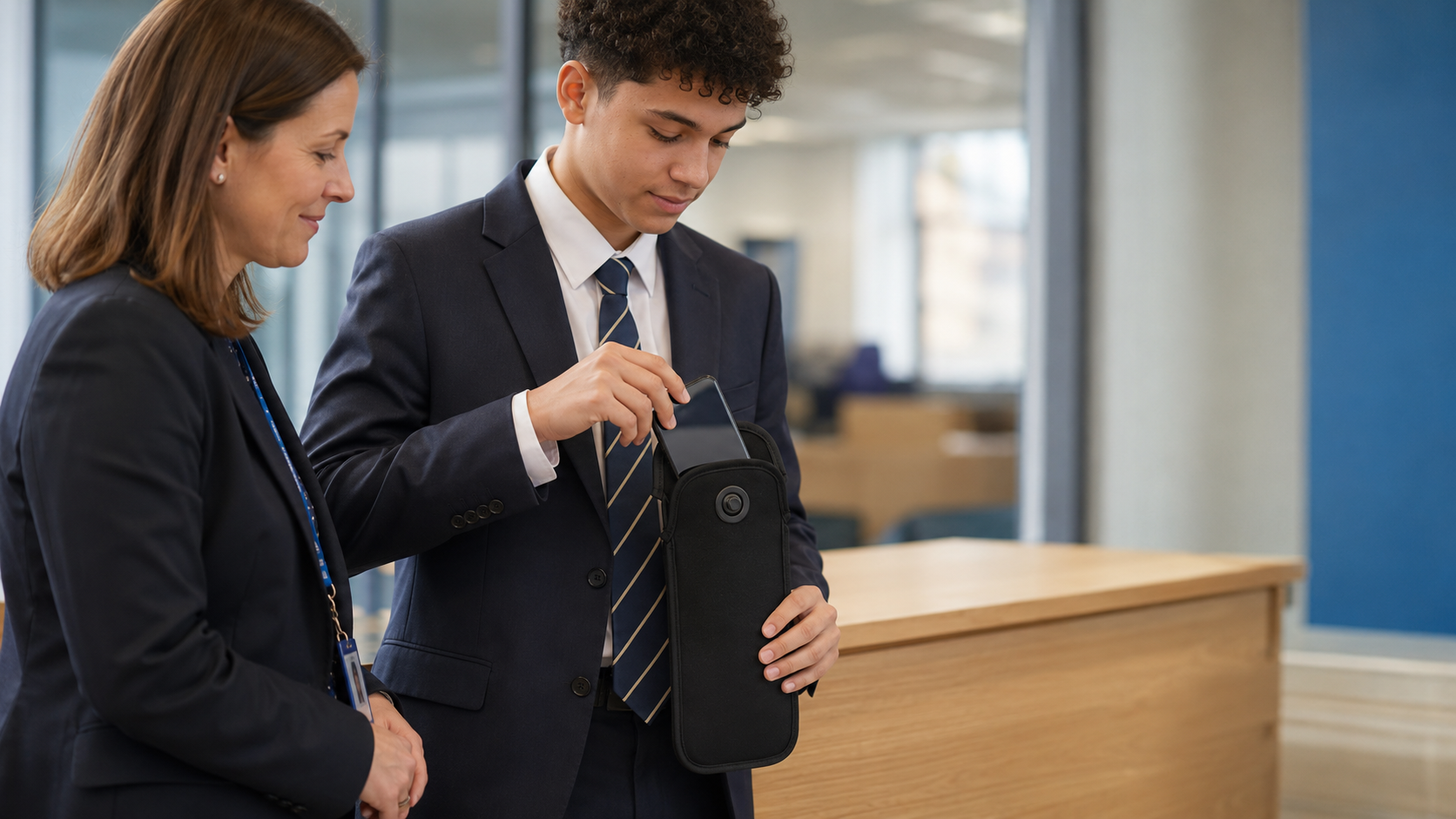
Schools searching for a "phone lock box" or a "lockable box for phones" are usually solving one problem: how to make mobile phones genuinely inaccessible during the school day. There are two practical routes — a lockable storage box or cabinet that the school holds, or a lockable phone pouch that the pupil keeps. They behave very differently once you scale them to a whole year group.
The short answer
Lock boxes work well for small numbers — a single classroom, an exam room, a staff meeting or a sixth-form study space. Lockable pouches work better for a whole-school ban, because the school never takes custody of the device and there is no queue at the start and end of the day.
Side-by-side comparison
| Phone lock box / cabinet | Lockable phone pouch | |
|---|---|---|
| Who holds the phone | The school | The pupil |
| Liability for loss or damage | Sits with the school once collected | Stays with the pupil and their own device |
| Start and end of day | Collection and return queues per class | Pupils tap an unlocking base as they leave |
| Cost at 1,000 pupils | Cabinets, charging bays and staff time per room | One pouch per pupil plus a small number of shared bases |
| Emergency access | Someone must unlock the cabinet and find the device | Staff handheld key opens the pupil's pouch instantly |
| Best suited to | Single rooms, exams, small cohorts | Whole-school, all-day phone-free policies |
Where lock boxes struggle at scale
- Custody and liability. The moment a school locks away a £900 handset, the school owns the risk of loss, damage and disputes. Pouches avoid this entirely.
- Time. Collecting and returning phones in every form room costs a few minutes twice a day, which across a year is a significant amount of teaching time.
- Storage. Thirty-plus devices per room needs physical space, and normally power for charging complaints to disappear.
- Consistency. If one department opts out, the policy weakens. Pouches make the rule identical for every pupil in every corridor.

When a lock box is still the right tool
Lockable boxes remain useful for exam halls, confiscation storage, staff CPD sessions and small sixth-form settings where numbers are low and supervision is close. Plenty of schools run both: pouches for the day-to-day policy and a small lockable cabinet in the office for exceptions.
Choosing between them
- Whole-school, all-day ban across 300+ pupils — pouches are usually the practical choice.
- One department, an exam room or a small cohort — a lockable box is cheap and simple.
- Concerned about liability for expensive devices — pouches keep custody with the pupil.
- Need instant access for medical or safeguarding reasons — handheld keys beat a shared cabinet.
- Tight budget — compare a one-off pouch per pupil against cabinets plus recurring staff time.
What this means for the 2026 guidance
The DfE expects schools in England to be mobile-phone-free by default from 1 September 2026, and Scottish guidance encourages restrictions during teaching and learning. Neither specifies a method — what matters is that the restriction is clear, consistent and enforceable, with arrangements for medical needs and reasonable adjustments. See our DfE 2026 briefing for the detail.
Compare pouch sizes and unlocking equipment, read the cost guide, or request a sample pack to test the system with your leadership team.