

The Department for Education’s statutory guidance, Mobile phones in schools, says that schools in England should be mobile-phone-free by default and should prohibit pupils from accessing phones throughout the school day from 1 September 2026. In Scotland, the Scottish Government’s non-statutory Mobile phones: guidance for Scotland’s schools – updated 2026 encourages restrictions at least during teaching and learning and asks schools to consider whole-school bans.
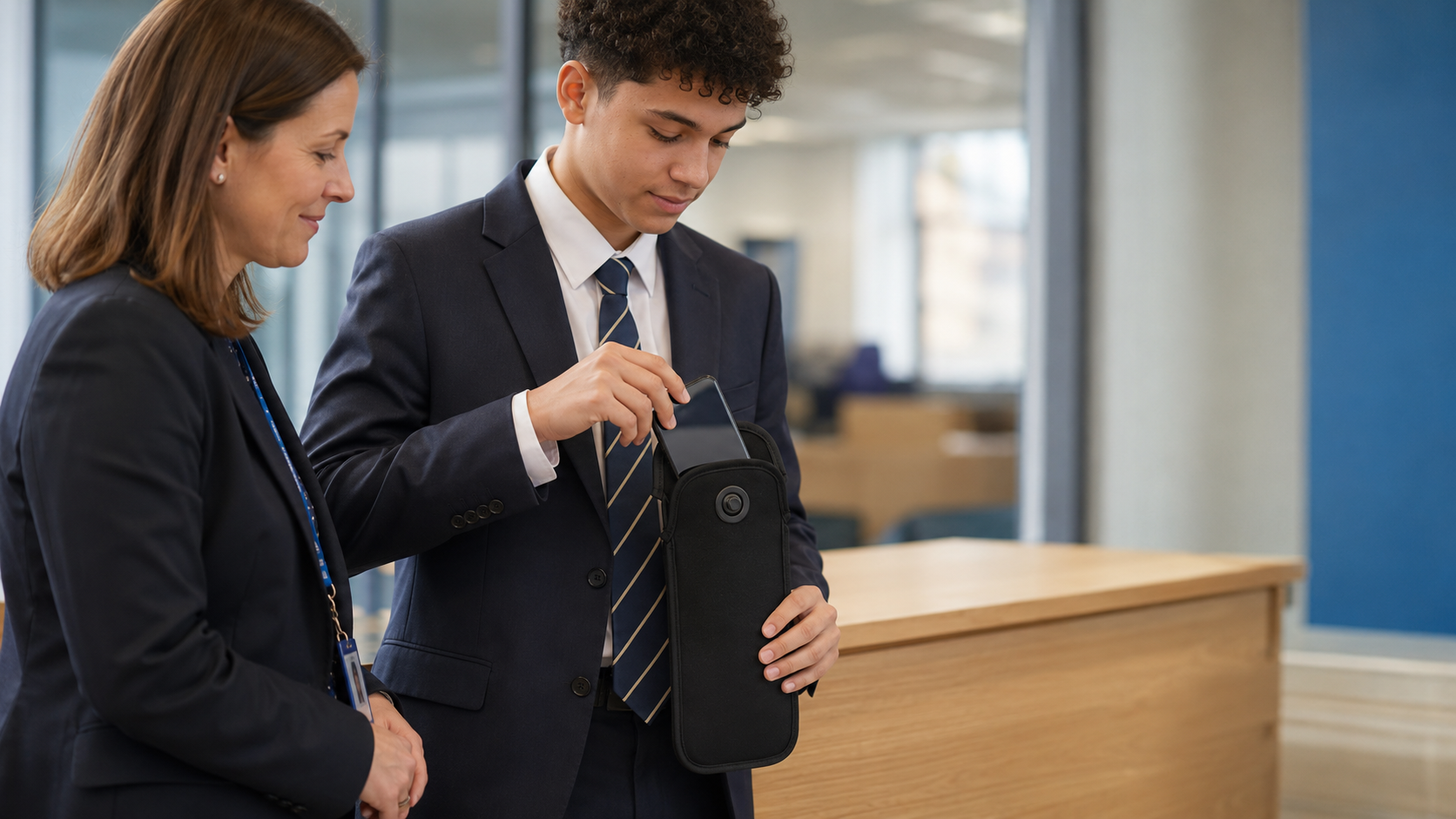
Lockable phone pouches offer schools a practical way to implement clear and consistent restrictions: pupils can keep their phones securely with them while the devices remain inaccessible during restricted periods, with appropriate arrangements for medical needs, reasonable adjustments and other agreed exemptions.
What “mobile-phone-free by default” means in practice
- The restriction covers the whole school day, not just lesson time — break, lunch and movement between lessons included.
- It applies to phones and, in most schools’ policies, to other devices that give the same access: smartwatches and earbuds.
- It should be the default position, with exemptions defined and documented rather than negotiated case by case at the gate.
How the four approaches compare
- Never seen, never used. Cheapest to state, hardest to enforce; relies on staff challenging every sighting.
- Handed in at the start of the day. Removes the phone but makes the school custodian of hundreds of valuable devices, with queues at both ends of the day.
- Locked away in a locker or classroom box. Better, but still school custody and still a movement bottleneck.
- Lockable pouches. The pupil keeps their own property, the phone is inaccessible, and there is no custody risk or hand-in queue. See how pouches work day to day.
A compliance checklist for September 2026
September 2026 readiness checklist
- Write or update the policy so the default position and the school day’s scope are explicit.
- Define exemptions: medical needs, reasonable adjustments under the Equality Act, agreed care plans, and any sixth-form variation.
- Set out the process for a genuine emergency, including how parents reach pupils via the office.
- Agree consequences and route them through the existing behaviour policy.
- Communicate with parents and pupils at least two weeks before launch.
- Choose the enforcement mechanism and order equipment with lead time for September.
- Plan a phased launch — one year group first, then whole school after a week.
- Review after a half term: gate flow, incidents, staff and parent feedback.
Scotland and the rest of the UK
Scotland’s guidance is non-statutory and gives headteachers the discretion to set the level of restriction, but the direction of travel is the same, and many councils are encouraging whole-school approaches. Schools in Wales and Northern Ireland are not covered by the DfE guidance but are widely adopting the same model.
Timing your rollout
Working back from 1 September 2026: agree the policy and enforcement method a full term ahead, order equipment at least six weeks before you need it, and start parent communications two weeks before launch. Schools that leave procurement to August find themselves competing with every other school doing the same thing.
Read our guidance and rollout support for schools, review the evidence on phone-free schools, or ask us for a quote for your pupil numbers.